
Stable performance of limestone powder granulating equipment determines the quality and efficiency of fertilizer production. In many industries, from agriculture to environmental remediation and building material processing, lime-based granules provide a stable source of nutrients, pH regulation, or chemical reactivity. When machinery operates continuously, operators often face irregular particle size, poor extrusion, or uneven moisture distribution. Continuous observation, adjustment, and precise control during granulation ensure reliable limestone fertilizer granule formation and consistent profitability.
1. What raw materials suit fertilizer production and how do specific industries benefit?
Fertilizer manufacturing uses various raw materials such as limestone powder, dolomite dust, calcium carbonate, gypsum, and magnesium lime. Each material provides unique physical and chemical conditions for granule formation. The agricultural fertilizer sector values fine lime powder because it improves soil structure and neutralizes acidity. The environmental treatment industry prefers limestone-based granules to capture sulfur oxides and neutralize acidic effluents. The metallurgical and construction sectors utilize lime rock particles to modify flux composition and enhance material bonding. Therefore, limestone fertilizer granulation combines chemical activation and mechanical shaping, which create versatile products for multiple applications. When each industry selects its powder source carefully, the subsequent pelletizing or ball-making stage becomes easier and more efficient, reducing waste and improving granule uniformity.
2. How can operators identify and correct granulation inconsistencies?
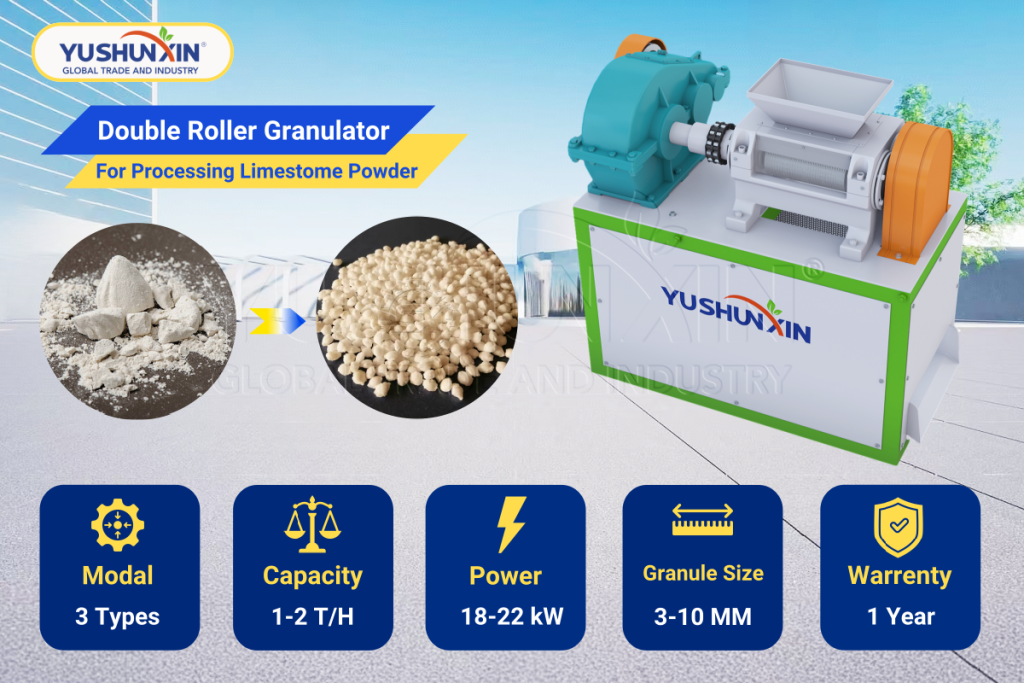
Limestone powder granulating equipment includes multiple machines: loader-type feeders, chain crushers, horizontal mixers, double roller extrusion granulators, rotary screening machines, automatic packaging scales, and belt conveyors. Each machine influences granule density, shape, and distribution. A typical problem occurs when raw material moisture fluctuates, causing weak extrusion or surface cracking during dry granulation. The operator adjusts the mixing rate and feed uniformity to stabilize the double roller press pressure. Another issue appears when the chain crusher leaves oversized particles that reduce extrusion quality. Regular inspection of the crushing chamber and replacement of worn blades maintain consistent particle fineness. When rotary screening machines separate undersized granules, the operator can return the powder to the mixer through belt conveyors for reprocessing. Continuous monitoring of each stage allows the manufacturing procedure to remain balanced, and the limestone fertilizer granule output reaches the required mechanical strength and chemical stability.
3. What are the benefits of proper maintenance and controlled extrusion pressure?
During limestone fertilizer pelletizing, consistent extrusion force and even feeding keep the pressing zone stable. A double roller extruder forms compact particles without excess moisture, preventing caking during storage. Inadequate lubrication or roller misalignment affects the extrusion contact, creating irregular granules and reducing operational efficiency. When machinery receives timely maintenance, the dry granulation process becomes smooth and energy-saving. The operator gains higher production yield and lower power consumption. The horizontal mixer ensures uniform blending of lime rock powder with other additives, while the automatic packaging scale guarantees accurate measurement, reducing product loss. A well-maintained granulator extends service life, improves pellet hardness, and supports continuous operation across multiple shifts. Consistent compacting pressure also reduces dust emission during pellet making, improving the working environment and product cleanliness.
4. How does integrated process control improve limestone powder fertilizer manufacturing?
Limestone fertilizer pellet production requires close coordination between material preparation, pressing, screening, and packaging. When operators apply digital controls or feedback systems, the entire granulation line achieves better synchronization. Belt conveyors link each step smoothly, while automatic sensors monitor powder flow and roller load. When the process data indicate abnormal vibration or temperature rise, technicians can adjust feeding rates, roller gap, or moisture level promptly. Through comprehensive process management, limestone powder granulating machines maintain steady output and reduce downtime. Integration between mechanical reliability and chemical accuracy guarantees that each granule meets industrial and agricultural specifications.
Conclusion
Efficient troubleshooting of limestone powder granulating equipment depends on consistent inspection, balanced feed control, and proper machine coordination. Each stage—from crushing and mixing to dry granulation and screening—affects final particle quality. When operators apply systematic maintenance and process adjustments, limestone fertilizer manufacturing achieves optimal stability and cost-effectiveness. For companies seeking advanced technology and reliable performance, cooperation with a professional fertilizer equipment manufacturer—Yushunxin provides practical solutions and durable machinery for lime powder fertilizer granulation lines. You can visit: https://www.extruder-granulator.com/product/limestone-powder-granulation-machine/