
Setting up an NPK compound fertilizer pelletizing plant requires careful budgeting across multiple categories. From selecting raw materials to purchasing pellet-making equipment, each cost component directly impacts the total fertilizer manufacturing plant cost. To help investors and factory planners understand the required investment, this blog explains the key cost segments and machinery considerations in compound fertilizer production.
What Raw Materials Can Be Used in NPK Compound Fertilizer Pellet Production?
Selecting proper raw materials serves as the foundation of compound fertilizer granule manufacturing. Common choices include nitrogen sources such as urea and ammonium sulfate, phosphorus materials like monoammonium phosphate (MAP) and diammonium phosphate (DAP), and potassium carriers such as potassium chloride (KCl) and potassium sulfate. Many factories also blend micro-nutrients or fillers like bentonite, zeolite, and dolomite to balance nutrient content or improve pellet texture. These solid powdery substances support stable particle formation during the granulating process. Using suitable raw materials enhances production efficiency and reduces pellet breakage, ensuring that granulation output meets both quality and volume expectations.
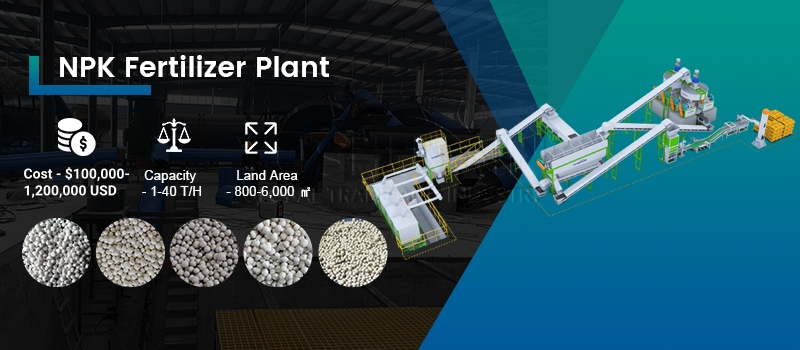
How Is the Cost of NPK Fertilizer Pelletizing Equipment Structured?
NPK fertilizer plant cost primarily includes granulating machinery and supporting equipment. Among common granulator choices are disc granulators for flexible control over granule diameter, rotary drum granulators for large-scale continuous production, and double roller extrusion granulators suitable for low-moisture materials. Each granulator type influences both machine price and energy consumption.
Besides pelletizers, a complete production line requires additional machinery such as batching machines for precise ingredient feeding, rotary drying machines to lower pellet moisture, and packing machines for automated bagging. The combination of these machines affects the total compound fertilizer production plant cost. Investors should also consider the cost of electrical wiring, factory layout design, steel frames, dust collectors, and maintenance accessories. Typically, medium-capacity NPK fertilizer pellet production lines range between USD 30,000 to USD 120,000 depending on output scale and automation level.
What Factors Influence the Total NPK Fertilizer Factory Setup Cost?
The fertilizer factory cost includes more than just equipment prices. Transportation, installation, workshop construction, labor, and electricity all contribute to the final budget. For example, shipping pelletizing machinery to overseas locations increases logistics costs, especially for heavy rotary granulators and drying machines. If the installation site lacks infrastructure, builders must invest in flooring, ventilation, and safety systems. Additionally, the number of operators required depends on the degree of automation; high-efficiency lines reduce labor expenses but raise the initial machinery investment.
Local energy prices, environmental compliance policies, and raw material accessibility also shape long-term npk fertilizer manufacturing plant costs. Producers in resource-rich areas may lower costs through bulk raw material purchases or stable utility supplies. These external conditions should guide equipment selection and layout planning, allowing for a balance between operational efficiency and upfront investment.
Conclusion
Investors aiming to build a cost-effective NPK compound fertilizer granulation line should evaluate all cost elements, from raw material suitability and pelletizer types to infrastructure and operating expenses. Each machine in the granulating process—from crushing units to granule screening machines—plays a role in shaping the final production cost and output quality. Selecting a mature solution with integrated equipment can help reduce overall fertilizer plant setup cost and shorten the commissioning cycle.
A professional fertilizer equipment manufacturer—Yushunxin—offers customized NPK compound fertilizer pellet production plans based on actual capacity demands and budget preferences. Their advanced machinery supports granule shaping, material drying, and bagging, helping fertilizer factories streamline production and control operating expenses. You can visit: https://www.fertilizerproductequipment.com/npk-fetilizer-plant-cost/