
In the ever-evolving field of fertilizer manufacturing, the demand for efficient and high-quality production of granulated lime fertilizer continues to grow. As industries seek more sustainable and cost-effective solutions, extrusion technology has emerged as a pivotal process in the preparation of lime-based fertilizer granules. This article explores the advantages of extrusion for granulated lime fertilizer production, provides examples of raw materials, highlights key industries, and examines the essential machinery used in the production line.
Which Raw Materials Suit the Granulation of Lime-Based Fertilizers and What Are Their Industry Benefits?
The selection of raw materials plays a decisive role in the granulation of lime fertilizer. Typical choices include lime powder, limestone flour, hydrated lime, quicklime, and dolomitic lime. Each material offers unique characteristics for different industries.
For the environmental sector, lime powder effectively neutralizes acidic soils and supports wastewater treatment by adjusting pH levels. Hydrated lime, due to its high reactivity, finds application in the chemical industry, particularly for flue gas desulfurization and water purification. The construction materials sector, on the other hand, favors dolomitic lime for its magnesium content, which supports soil structure improvement. Industries such as mining and metallurgy select quicklime or limestone powder to stabilize soils and reduce environmental hazards during processing operations.
Each sector requires granules with consistent size and mechanical strength to ensure uniform application, easy handling, and minimal dust generation. The granulation of lime rock into fertilizer pellets addresses these specific needs, enhances product performance, and broadens the applicability of such fertilizers across numerous fields.
How Does Extrusion Technology Transform Lime Fertilizer Granule Production Procedures?
Extrusion technology, especially through double roller compactors, revolutionizes the procedure of lime fertilizer pellet making. The process begins when raw materials pass through a loader type feeder, which ensures uniform feeding. A crain crusher subsequently reduces the particle size, preparing the lime rock for optimal mixing. The horizontal mixer then blends the materials evenly, supporting both homogeneity and granule quality.
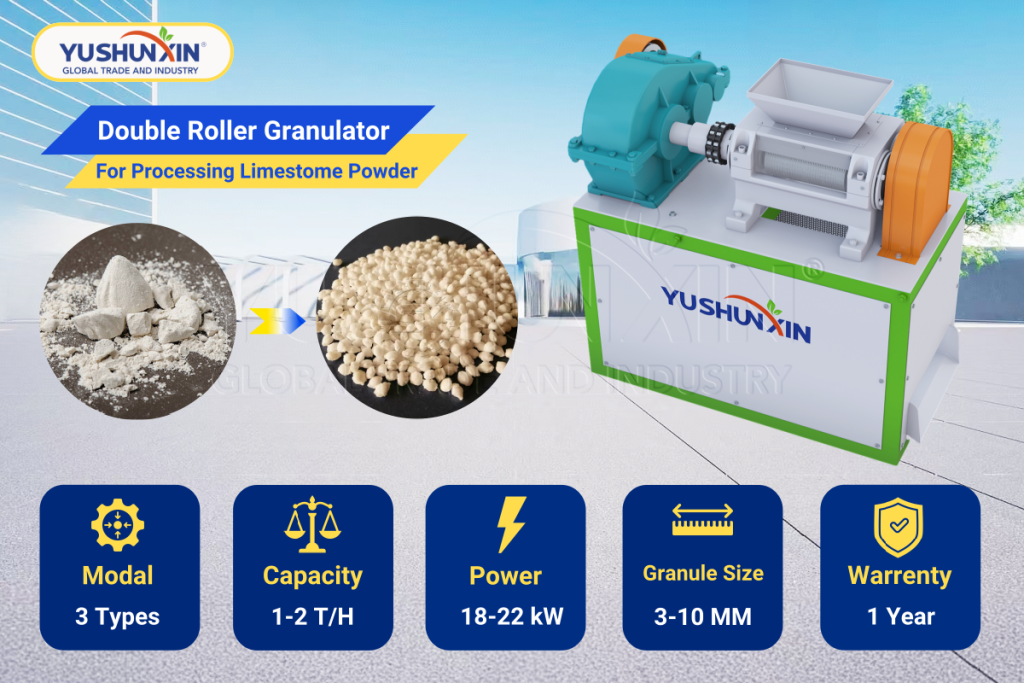
At the heart of the production line, the double roller extrusion granulator compresses the blended lime powder into dense sheets or preformed strips. The extruder applies controlled pressure, transforming the powder into robust lime fertilizer granules. Unlike wet granulation, dry extrusion requires no additional liquid binders, thus conserving energy and avoiding unnecessary drying steps. The resulting granules exhibit higher mechanical strength, improved storage stability, and minimal caking tendencies.
Next, a rotary screening machine sorts the pellets according to size, ensuring consistent particle distribution. Oversized and undersized materials return via belt conveyors for further processing, while qualified pellets proceed to automatic packaging scales. This closed-loop process guarantees efficient lime fertilizer pelletizing, reduces production costs, and minimizes waste.
What Are the Key Machine Features in Lime Fertilizer Granule Manufacturing?
Efficient granulation of lime-based fertilizer relies on the integration of various specialized machines. The loader type feeder handles bulk material transfer and metering, while the crain crusher achieves fine particle size necessary for consistent granulation. Horizontal mixers provide uniform blending of raw materials, a critical step before extrusion.
The double roller extrusion granulator serves as the core pelletizer, utilizing advanced pressing and compacting mechanisms. Its design supports adjustable pressure settings and variable roller speeds, enabling users to customize pellet dimensions. Rotary screening machines separate granules by size, maximizing yield and ensuring end-product quality. Automatic packaging scales and belt conveyors streamline the entire operation, supporting continuous production and reducing manual labor.
These machines collectively ensure that lime rock granule preparation remains efficient, flexible, and scalable, meeting the specific requirements of clients in diverse sectors.
Why Choose Extrusion Technology for Lime Fertilizer Granulation?
The advantages of extrusion technology in lime fertilizer particle production are significant. The process enables precise control over granule size and density, essential for specialized industrial applications. Dry extrusion minimizes operational costs and energy consumption by eliminating the need for drying, while also reducing environmental impact. The closed-loop system ensures consistent quality, optimized yield, and minimal waste.
For businesses aiming to improve lime-based fertilizer granule production, selecting the right equipment is critical. A professional fertilizer equipment manufacturer, such as Yushunxin, offers comprehensive solutions that encompass every stage of the granulation process—from raw material preparation to final packaging—helping clients achieve superior product quality, operational efficiency, and sustainable growth. You can visit: https://www.extruder-granulator.com/product/limestone-powder-granulation-machine/