
High moisture organic waste always challenges industries that aim to transform it into valuable fertilizer products. Fruit pomace, vegetable residues, brewery grains, and food-processing sludge usually contain more than 80% water. Each type of raw material requires a specific moisture reduction procedure according to its composition. The beverage industry generates apple pomace and grape pomace, while the edible oil industry produces olive pomace. These materials decompose quickly if not treated through proper dehydration or drying systems. In fertilizer production, excessive moisture reduces storage stability, increases transportation cost, and slows down composting and granulation performance. Therefore, reliable pomace drying equipment enables manufacturers to handle pomace efficiently and to prepare it for further compost or particle formation.
Why Drying Becomes the Core Stage in Pomace Fertilizer Preparation Process
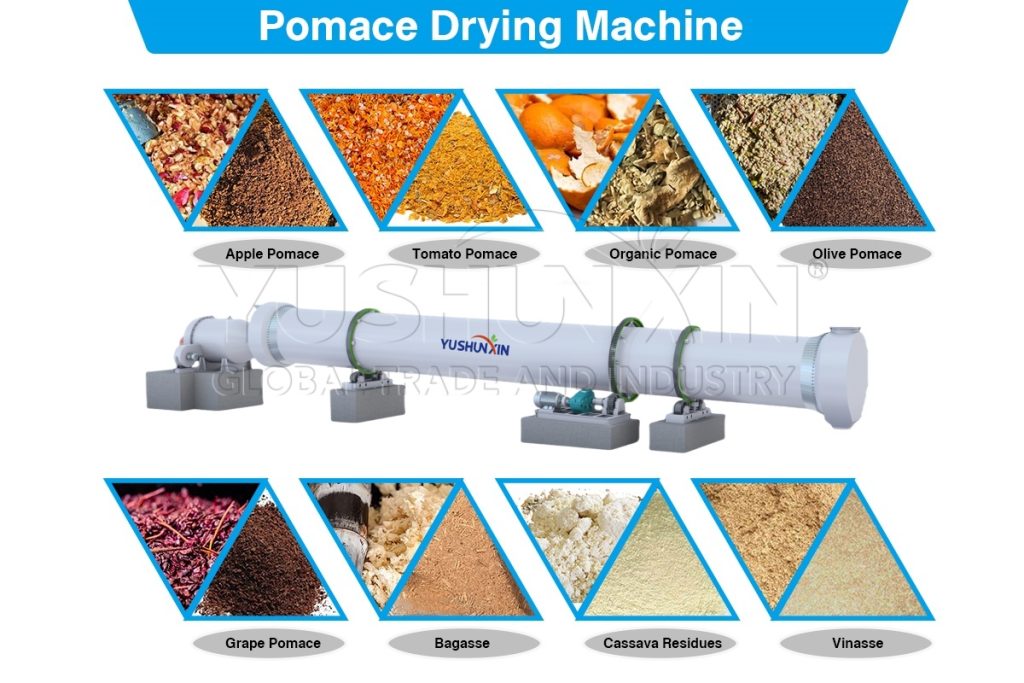
Drying plays a decisive role in the preparation of pomace for fertilizer manufacture because it controls water content before composting and pelletizing. When the pomace enters the production line, its moisture usually exceeds 85–90%. The drying process gradually reduces the water level to below 10%, ensuring smooth fertilizer granulation. During this procedure, the rotary drum dryer demonstrates consistent heat transfer and material tumbling motion, which promote uniform moisture reduction. The pomace dryer system not only accelerates the drying time but also stabilizes the organic composition for later composting and granule formation. As a result, the fertilizer manufacturing process gains efficiency, and the final pellet or granule product reaches the desired hardness and nutrient concentration. Drying technology therefore determines the operational rhythm of the entire fertilizer production chain.
How Different Machines Support the Moisture Reduction Process
A well-designed pomace fertilizer production line often includes several machines that work together for water removal. At the preliminary stage, a mechanical dewatering machine or screw press decreases free water content. This dewatering step prepares the pomace for the next stage of thermal dehydration. The rotary drum dryer then performs continuous drying, using controlled airflow and temperature design. After drying, the composting machine further stabilizes the organic matter by controlled fermentation, while the wet granulator or pelletizer shapes the material into uniform fertilizer particles. These four stages—dewatering, drying, composting, and granulating—can reduce moisture from more than 90% to less than 10%. Each machine cooperates within the integrated production system, ensuring that pomace and other organic residues transform into high-quality fertilizer pellets with consistent particle size and nutrient distribution.
What Benefits Do Manufacturers Gain from Efficient Drying Technology?
Efficient drying technology creates multiple benefits for fertilizer producers who use pomace as raw material. First, water reduction minimizes microbial spoilage and odor problems, enhancing safe storage and transportation. Second, optimized drying supports uniform composting reaction, which stabilizes organic carbon and nitrogen balance. Third, properly dried pomace feeds smoothly into the granulator or pellet making machinery, generating dense and durable fertilizer particles. In addition, energy-efficient drying systems lower operational cost and improve environmental sustainability by reducing fuel consumption. Manufacturers who adopt advanced pomace dryer achieve continuous production, stable product quality, and reduced waste disposal pressure. The drying process, therefore, becomes a key link connecting pomace preparation, composting, and granule formation within the fertilizer manufacturing procedure.
Conclusion
In conclusion, drying acts as the central link in the preparation of pomace for fertilizer manufacture. It connects dewatering, composting, and granulation processes into a coherent production chain. Through effective moisture control, the drying stage enables stable composting reactions and high-quality pellet or granule output. Rotating drum dryers remain the most practical choice for large-scale pomace drying because they provide continuous operation, uniform heat distribution, and easy integration with other fertilizer production machines. As the global demand for sustainable fertilizer products grows, equipment quality and system design gain increasing importance. A professional drying equipment manufacturer—Yushunxin—offers advanced pomace dryer machinery and comprehensive drying solutions that help fertilizer producers achieve efficient water reduction, consistent granule formation, and reliable production performance. You can visit: https://www.fertilizerdryer.com/pomace-drying-machine/