
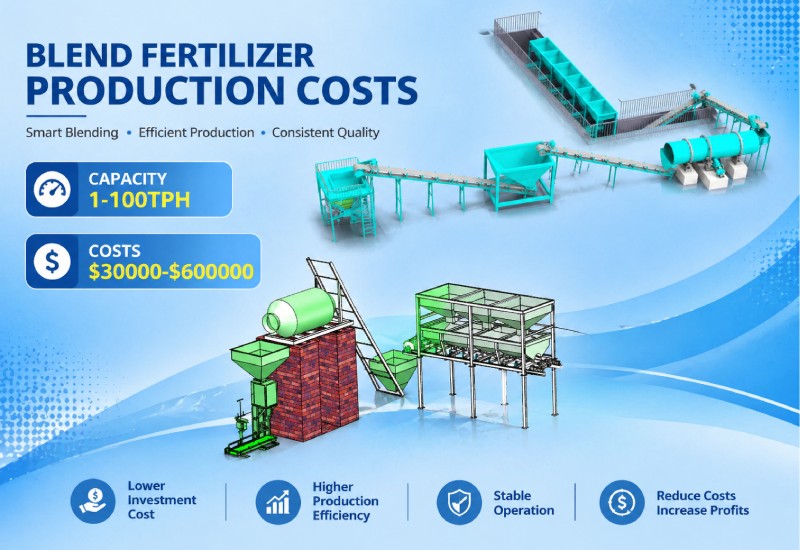
For fertilizer companies, agricultural distributors, and new investors, building a fertilizer blending plant is an efficient way to produce customized NPK formulas for local markets. Compared with complex granulation projects, a blending plant usually requires a shorter process, lower energy consumption, and faster installation. However, the total cost can still vary greatly. It depends on production capacity, automation level, raw material handling, packing method, and plant layout.
What Is Included in the Investment?
When buyers ask about BB fertilizer production project investment, they should not only consider the price of the main mixer. A complete project normally includes raw material storage bins, automatic batching machines, belt conveyors, BB fertilizer mixer, finished product silo, packing scale, control cabinet, dust collection system, installation support, and spare parts.
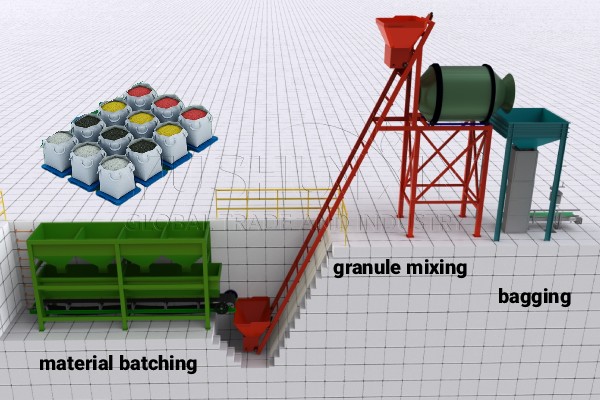
For a small or medium plant, semi-automatic equipment may be enough. For a large fertilizer company, a fully automatic system can improve weighing accuracy, reduce labor costs, and support continuous production. Therefore, the first step is to confirm your target capacity and formula requirements.
Main Factors That Affect the Cost
The NPK fertilizer blending plant setup cost is mainly influenced by five factors. The first is capacity. A 5 TPH line and a 30 TPH line need different batching systems, mixer sizes, conveyors, and packing machines. The second is automation level. Manual feeding is cheaper, while automatic weighing and PLC control require a higher budget.
The third factor is raw material type. If you use urea, DAP, MOP, ammonium sulfate, or granular NPK materials, their particle size and flowability will affect equipment design. The fourth factor is packaging. Some projects use 25 kg or 50 kg bags, while others require jumbo bag packing. The fifth factor is local installation conditions, including workshop size, power supply, foundation, and labor availability.
Why Process Flow Matters
A clear process design can help reduce unnecessary equipment and avoid repeated material handling. A typical blending plant includes raw material feeding, automatic batching, material conveying, uniform mixing, temporary storage, weighing, packing, and sealing. For buyers who want a Cost-effctive blend fertilizer production process flow, the key is to match the equipment with real production demand instead of choosing the most expensive configuration.
For example, if the buyer only produces several fixed formulas, a simpler batching system may be suitable. If the buyer needs to change formulas frequently, a more flexible computerized control system is better.
How to Get an Accurate Quotation
A reliable PLC controlled fertilizer blending line quotation should be based on detailed project information. Before requesting a price, buyers should prepare the required capacity, raw material names, number of formulas, package size, workshop dimensions, and expected automation level. With this information, the manufacturer can provide a more practical equipment list and layout design. Get it now!
Choosing the Right Supplier
Working with a professional bulk blending fertilizer system equipment supplier can help buyers avoid design mistakes and hidden costs. A good supplier should provide process design, equipment selection, layout drawings, installation guidance, and after-sales support.
In conclusion, the cost of a fertilizer blending plant is not fixed. It is a project-based investment. The best solution is not always the cheapest one, but the one that matches your capacity, formula, labor condition, and market plan.If you are interested in the project, you can visit https://www.mixedfertilizermachines.com/products/fertilizer-blending-plant-cost/