
Modern lime fertilizer manufacturing develops rapidly, and every producer faces higher requirements for efficiency, consistency, and controllable cost. The integration of advanced machinery gives the lime fertilizer production line stable output, uniform particles, and reliable quality. At the same time, well‑designed equipment reduces manual operations and energy waste, so the whole lime fertilizer granulation process becomes more predictable and scalable. Therefore, each enterprise can realize standardized lime fertilizer pellet production and enhance market competitiveness.
What Types of Raw Materials Suit Lime Fertilizer Granulation and How Does Each Industry Benefit?
Lime fertilizer manufacturers usually choose raw materials such as quicklime, hydrated lime, limestone powder, lime rock fines, and various calcium‑rich industrial by‑products. For example, steel plants generate lime‑containing dust and slag; after appropriate crushing and proportioning, these materials enter lime fertilizer pellet production and create new value instead of disposal costs. Cement plants also supply fine limestone powder, and this material supports stable lime granule forming because of its uniform particle size and high calcium content.
Environmental service companies collect flue gas desulfurization gypsum and combine it with lime powder in controlled granulation procedures. This combination supports soil conditioning, sulfur supplementation, and acid‑neutralization effects. Municipal sludge treatment projects sometimes add lime rock particles during stabilization; later, part of this lime‑treated sludge enters fertilizer manufacturing to improve organic‑inorganic compound products. In addition, mining enterprises use surplus limestone fines for lime pellet making lines, so the resource utilization rate increases. Each industry therefore gains waste reduction, product diversification, and revenue expansion through specialized lime fertilizer particle production.
How Do Key Machines Coordinate to Optimize Lime Fertilizer Granulation Procedures?
Lime fertilizer production requires stable feeding, uniform mixing, precise granulating, accurate screening, and reliable packing. A loader type feeder undertakes the initial material loading task and maintains continuous feeding of lime rock fragments, limestone powder, and auxiliary nutrients. This device keeps the material layer stable on the belt, so the subsequent lime fertilizer pelletizing stage receives consistent throughput. Then a chain crusher breaks agglomerated lime powder or caked additives into small particles, and this step protects the downstream extruder and promotes even granule structure.
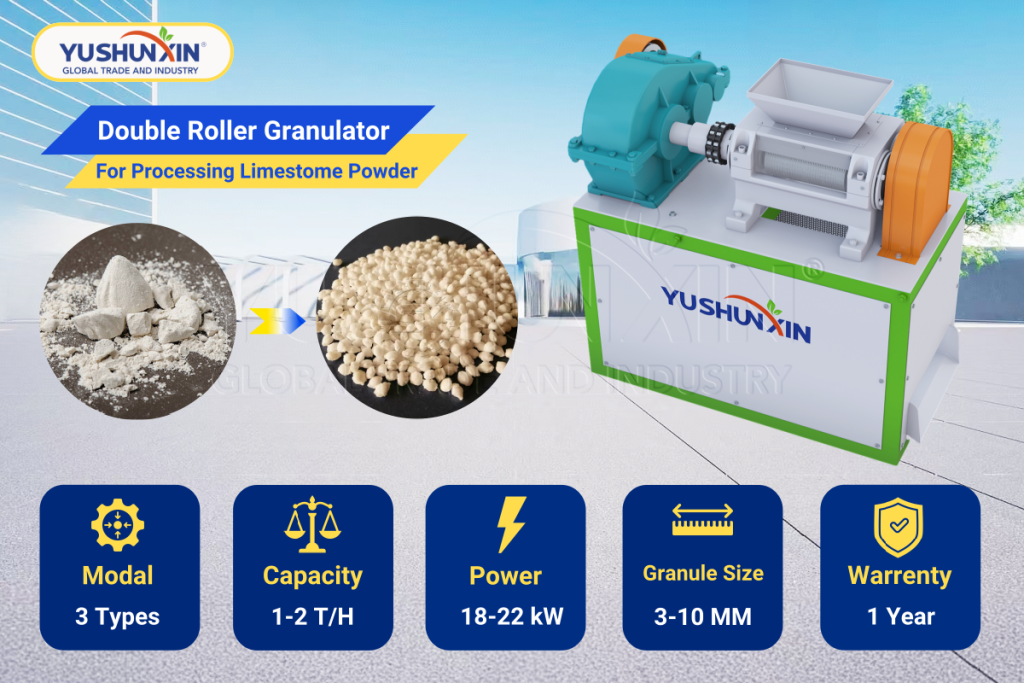
A horizontal mixer then blends lime materials with other components such as magnesium sources, trace elements, or organic carriers. This mixer keeps each lime fertilizer particle homogeneous in composition, because the mixing paddles create strong convection, shear, and diffusion motions. After thorough preparation, a double roller extrusion granulator performs dry granulation. The rollers compact the blended powder under adjustable pressure, so lime-based material forms dense sheets and then breaks into uniform pellets without additional drying. This compacting extrusion granulator particularly suits lime fertilizer production lines because lime materials often show good compressibility and low moisture demand.
Why Does Advanced Granulation and Screening Technology Improve Lime Fertilizer Particle Quality?
In lime fertilizer manufacturing, granulation quality directly affects spreading performance, dust emission, and nutrient release behavior. The double roller dry granulation procedure creates nearly spherical or pillow‑shaped pellets by mechanical pressing instead of liquid binding, so the moisture content remains low and the drying section can stay simple. In addition, precise roller surface patterns and adjustable gap control help lime fertilizer granules maintain consistent size and strength, so these particles resist breakage during transport and application. Compared with traditional wet pelletizing, dry extrusion granulation reduces binder usage and energy consumption and gives the operator flexible formula switching.
After granulating, a rotary screening machine separates qualified lime fertilizer particles, oversize granules, and fine powder. The screened oversize pellets return to the chain crusher and horizontal mixer for re‑granulating, and the under‑size powder returns directly to the double roller press compacting section. This closed‑loop process improves raw material utilization and ensures that only standard granules enter packaging. During this stage, belt conveyors link each machine and keep the lime fertilizer production process continuous. As a result, the entire lime fertilizer pellet manufacturing line shows stable capacity, controlled particle gradation, and reduced manual handling.
How Does Automated Conveying and Packaging Strengthen Lime Fertilizer Production Efficiency?
When the lime fertilizer particles pass through screening, the production line needs efficient conveying and precise packaging. Multiple belt conveyors transfer the lime granules smoothly between the loader type feeder, crusher, mixer, extrusion granulator, rotary screener, and final storage. This automated material flow reduces spillage and cross‑contamination and keeps lime fertilizer granulation operations clean. The modular conveyor layout also allows flexible line extension, so each enterprise can adjust capacity according to future lime fertilizer market demand.
An automatic packaging scale then weighs and fills the finished lime fertilizer pellets into bags with high accuracy. This packaging equipment improves bag‑to‑bag weight consistency and accelerates shipment preparation, so lime fertilizer manufacturers shorten delivery cycles. In addition, integrated dust collection interfaces on machines such as the chain crusher, mixer, double roller extruder, and packing scale reduce airborne lime powder, and this environmental control improves workshop conditions and equipment service life. Through these automation systems, lime fertilizer production lines become easier to monitor, and data from weighing, throughput, and energy consumption supports continuous optimization.
How Can Professional Lime Fertilizer Equipment Integration Support Long‑Term Production Upgrades?
Lime fertilizer producers usually need not only single machines but also integrated solutions that connect raw material preparation, granulation, screening, and packaging into one coordinated system. Proper equipment selection and technical alignment ensure that limestone powder flow properties match double roller extrusion pressure, that mixer capacity synchronizes with pelletizer throughput, and that rotary screening meshes correspond to target granule size distributions. Over the long term, this coordinated integration protects the producer from frequent line modifications and unstable product quality.
Therefore, each lime fertilizer manufacturer gains more benefit by cooperating with a professional fertilizer equipment supplier that understands lime production characteristics, dry granulation rules, and industrial by‑product utilization. A professional fertilizer equipment manufacturer – Yushunxin – provides such integrated design, including loader type feeder, chain crusher, horizontal mixer, double roller extrusion granulator, rotary screening machine, automatic packaging scale, and belt conveyors, so every client can build or upgrade a lime fertilizer production line with higher efficiency, better particle quality, and more reliable operation. You can visit: https://www.extruder-granulator.com/product/limestone-powder-granulation-machine/