
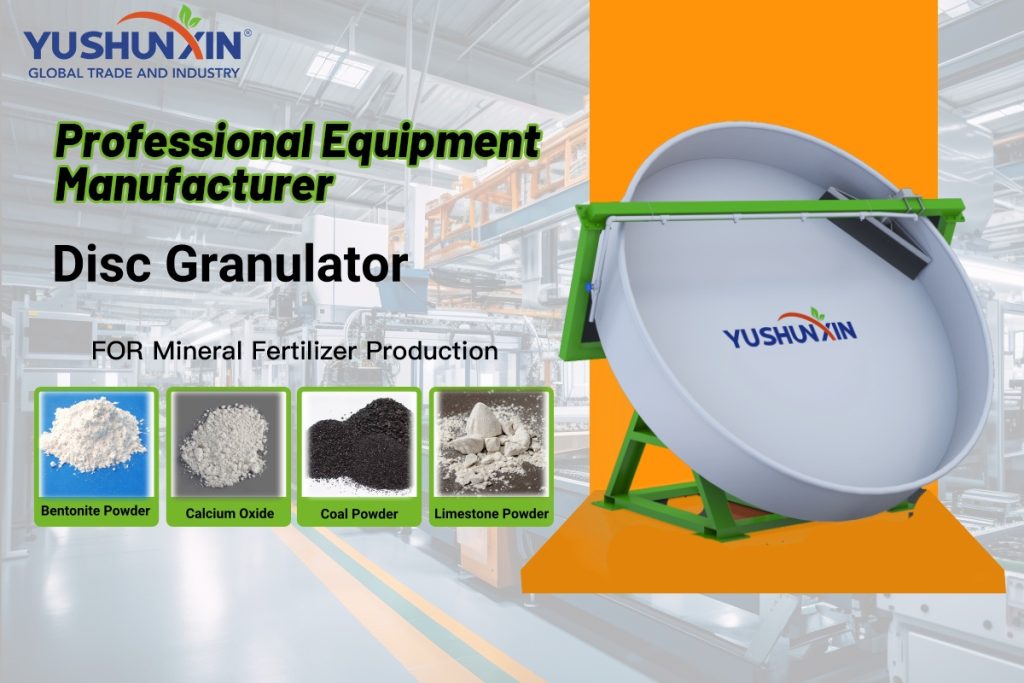
A disc granulator gives your plant a practical way to form mineral powder into 1–5 mm granules. You can control the final size by adjusting disc angle, rotation speed, spray moisture, feed rate, and scraper position. Plant owners who process phosphate rock, limestone, dolomite, and potassium feldspar can use this machine in a compact fertilizer production line. The rotating pan rolls the powder into round pellets while a spray system adds the right amount of moisture.
How can a disc granulator control 1–5 mm mineral fertilizer granule size?
Your operators can set the disc angle and rotation speed so the powder rolls into the desired size range. A steeper angle keeps material in the pan longer and builds larger granules, while a flatter angle discharges smaller pellets sooner. The scraper removes sticky powder from the disc edge and keeps the rolling bed uniform. When your team keeps the feed rate steady, the machine produces fewer oversized particles. This control helps a mineral fertilizer granulation production line meet a consistent 1–5 mm specification for screening and packaging.
Which disc parameters influence mineral fertilizer granule size?
Disc diameter, edge height, rotation speed, and motor power all influence granule formation. A larger disc with a higher edge can hold more powder and produce greater capacity, while a smaller model suits laboratory work or small batches. You can also adjust the tilt angle to change how long material stays in the pan. When processing phosphate rock or limestone, your team can match the speed to the powder density. These settings help a phosphate rock processing line produce uniform pellets without excessive fines.
How do spray systems and disc angle support a mineral fertilizer granulation production line?
A spray system adds water or a binding solution to the moving powder and helps small particles stick together. Your operators can place the spray nozzles near the rolling bed so the liquid distributes evenly. The disc angle works with the spray to control granule growth, while the scraper keeps the pan surface clean. This combination gives the fertilizer equipment a steady granulation ratio and reduces dust. You can also add a microbial solution when the product requires biological activity. A measured mineral fertilizer granulation technology supports repeatable size control across long production runs.
How does a disc granulation production line connect to a fertilizer manufacturing system?
You can connect a crusher, a screen, and a conveyor to the disc granulator to form a complete flow. The crusher prepares limestone, dolomite, and potassium feldspar to a fine powder, while the screen separates 1–5 mm granules from undersized material. Your team can return fine particles to the pan for another pass. This arrangement keeps the fertilizer manufacturing process stable and reduces raw material waste. For background on mineral nutrients, you can read the mineral fertilizer reference. A mineral fertilizer equipment manufacturer can provide disc sizes, motor data, and installation guidance for your plant.
Yushunxin offers disc granulators and related mineral fertilizer equipment for size-controlled production. If your team has interest in the machine, you can learn more about https://www.mineralfertilizerproductionsolutions.com/product/disc-granulator-machine.