
Freeze-dried soup ingredients sell on aroma, color, and fast rehydration. Carrots, onions, spinach, mushrooms, and herbs lose that value quickly once heat drives the drying step. A 100㎡ freeze dry equipment setup gives a freeze-dried soup ingredient factory enough shelf area to dry real volume at low temperature. Hadof builds that line from washing through sealing around your material, output, and plant layout.
Which Materials Fit a Freeze-Dried Soup Ingredient Factory?
Many vegetables and aromatics suit this process, so one freeze-dried soup ingredient factory can run several recipes. Carrots and pumpkin hold their color well because carotenoids stay stable at low temperature. Onions, leeks, and celery keep volatile aroma compounds when water leaves as vapor. Spinach, herbs, and mushrooms rehydrate fast and return to a near-fresh texture. What's more, cooked legumes and minced meat dry well after a vegetable blanching machine pass. Each recipe changes slice size, tray depth, and cycle length, yet the same line handles all of them. Root vegetables carry more water than leafy greens, so their cycle length differs. Aromatics need a delicate cut, because volatile oils escape from damaged cells.
Why Does a 100㎡ Chamber Match Industrial Soup Volume?
Shelf area sets batch volume, so a larger chamber carries more wet material per cycle. Hadof sizes the 100㎡ industrial freeze dry equipment with 17 shelf layers at 70 mm spacing. Because the condenser removes 2000 kg of water per batch, long wet loads still finish on schedule. Meanwhile, tray depth and door height stay simple, so operators keep one rhythm across shifts. Tray loading depth then sets how much each layer carries, so the batch weight stays predictable. A plant that dries fresh vegetables and aromatics in commercial volume therefore fits this class of machine.
How Do the Production Steps Flow on One Line?
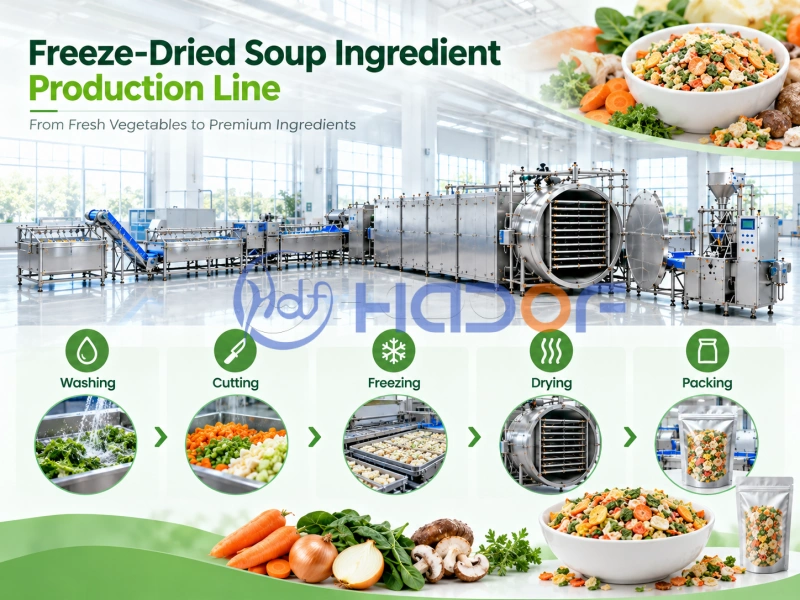
Raw material enters at the washing stage and leaves as a sealed bag. Every step between sits in one fixed order. First, washing removes soil, grit, and surface microbes, while water carries fine debris away. Then, blanching fixes color and shortens the drying stage that follows. After that, a slicer cuts the produce into even pieces, so each piece dries at the same speed. Next, a vibrating dewatering machine strips surface water, because free water lengthens the vacuum stage. Finally, a freezer locks the cell structure before trays roll into the chamber. Inside the chamber, pressure drops below 5 Pa, so ice turns straight into vapor. The condenser traps that vapor, while the dried load moves toward packing. One steady packing rhythm seals each bag before humid air returns moisture. Any missing step then shows up later as uneven color, wet centers, or short shelf life.
What Equipment Makes Up the Complete Line?
Hadof designs the six sections below as one matched set, so each station feeds the next at the same rate. Material moves from washing to packing without manual re-handling.
1. Pre-treatment Equipment
Bubble cleaning and blanching remove soil and stabilize color before any cutting step. They stop enzymes that would otherwise dull flavor during storage, so color holds for months. Sizing also matters, because oversize units waste water and power on small loads.
2. Cutting Equipment
In practice, a slicer or dicer sets one uniform piece size across the batch. Even pieces dry at the same speed, so the chamber never runs a partly wet load. Blunt blades crush cells, so a sharp set protects texture and yield.
3. Freezing Equipment
Tunnel freezing or quick freezing drops product temperature fast before drying. Small ice crystals then protect cell walls, so color and aroma survive the vacuum stage. Cycle time then depends on load depth rather than machine size alone.
4. Conveying Equipment
Belt and bucket conveyors link washing, cutting, freezing, and packing into one flow. Gentle transfer also reduces breakage on fragile dried pieces. Transfer speed between stations then sets the overall line rate.
5. Vacuum Freeze Drying Equipment
The HDF-100 chamber dries the frozen load under vacuum with an ultimate pressure of 5 Pa. Shelf temperature stays within ±1 °C, so every tray dries at the same rate. Defrost between cycles keeps daily throughput steady, even in humid conditions.
6. Packing Equipment
Right after drying, a food packing machine fills, seals, and codes each bag. Nitrogen flushing or vacuum sealing then blocks moisture during long sea transit. Seal testing confirms barrier quality before cases leave the plant.
What Parameters and Technical Advantages Matter?
Parameter choice decides cycle time, energy cost, and product consistency across every batch.
| Parameter | Typical Value |
| Shelf area | 100 m², 17+1 layers, 70 mm spacing |
| Ultimate vacuum | ≤5 Pa |
| Shelf temperature uniformity | ±1 °C |
| Condenser temperature | -40 °C or -60 °C, dual compressor for deep freeze |
| Water catch capacity | 2000 kg/batch |
| Chamber material | SUS304 food-grade stainless steel |
| Refrigerant | R507A |
| Power supply | 380 V, 3 phase, 50 Hz |
| Installed power | 260 kW |
| Defrost method | Spray water defrost |
Spray defrost shortens cleaning between cycles, so daily uptime stays high. Spacing of 70 mm also keeps airflow steady between trays during the vacuum stage. And stainless surfaces resist corrosion in wet washing areas. Hadof also holds ISO9001 and CE certification for this equipment.
How Do You Plan Price and Floor Space?
Cost and layout work together, so plan the building around the chamber size first. This 100㎡ unit measures about 13500 × 2500 × 3200 mm, and that footprint sets the clear height you need. Then add aisle space for loading, unloading, and maintenance around the frame. Wet preparation areas near the washing and cutting stations need floor drains and easy cleaning access. Also, power planning matters, because this class of machine draws 260 kW at 380 V. Such a layout removes the need for lifts and keeps transfer routes short. Besides, placing packing close to the chamber door limits exposure time for dried product. Truck access and door width then decide whether the chamber arrives in one piece or in sections. Therefore, one accurate floor plan usually lowers both civil work and daily labor.
Which Problems Does a Complete Line Remove?
Single-machine setups often stall at the handover points, and those stalls cost more than the machines themselves. One complete line therefore removes manual re-handling between stations. Even cutting and dewatering shorten cycle time, so the chamber turns more batches each month. Matched freezing protects texture, which keeps premium buyers interested. Sealed packing right after drying protects shelf life during long transit. Uneven drying also shows up in complaints, so quality control costs more after shipment. As a result, labor planning gets simpler because fewer operators touch each load. A line built as one set therefore protects the margin that freeze-dried ingredients earn. What's more, one supplier for the full line keeps spare parts and service in one place.
Build the Freeze-Dried Soup Ingredient Line as One System
Every stage either protects the dried product or spends it, so one design should cover the whole line. Then washing, cutting, freezing, drying, and packing run to a single rhythm. For a customized solution, visit the Hadof freeze dryer homepage at https://www.freezehadof.com/.